Executive Summary
Clean energy has a cruel paradox: technologies improve while companies collapse. This essay argues that many failures are not primarily managerial mistakes but structural “phase transitions” triggered when irreversible commitments collide with rapidly shifting regimes—policy, market design, standards, and grid constraints. We introduce a practical lens built on two coordinates: irreversibility (how costly it is to unwind technology, contracts, and organizational commitments) and coupling (how tightly cash flows depend on external rules and counterparties). When either becomes high, projects can cross discrete boundaries where traditional, smooth risk models stop working and small shocks propagate into existential distress. The implication is operational: resilience is engineered, not hoped for. We outline a Triple Reduction strategy—physical modularity, financial/semantic bankability, and adaptive contract architecture—to lower irreversibility and coupling without sacrificing scale. For investors, the priority shifts from static IRR stories to survivability and exit optionality; for policymakers and regulators, predictability and queue transparency become capital infrastructure.
Clean energy has an uncomfortable paradox that polite industry narratives often hide: technologies succeed while companies fail.
Solar modules get cheaper, wind turbines scale, batteries extend duration, and grids learn how to absorb more variable generation—yet a non-trivial share of the firms building that progress still collapse in ways that look irrational to outsiders. If you only watch the technology curves, the story is triumphant. If you watch the balance sheets and refinancing calendars, the story is frequently brutal. The same development that benefits the grid can destroy the capital structures that financed yesterday’s assumptions.
Key quote: “The system can improve while companies collapse.”
When that happens, a project does not merely become “riskier.” It can become unfinanceable, unrepurposable, and unsellable at anything close to invested value. In that moment, what looks like ordinary volatility on a spreadsheet becomes a discontinuity in the real world: a boundary is crossed, and survival becomes a different game.
1. The Physics of Failure: Discontinuity, Not Gradual Decline
The standard explanation for clean-energy failures is usually managerial: wrong strategy, poor execution, weak governance, bad timing. That explanation is comforting because it preserves the illusion of control. But it fails to explain a recurring pattern: many ventures don’t slowly deteriorate into manageable distress—they snap.
A better metaphor comes from physics. Not because finance is physics, but because the metaphor captures the shape of collapse.
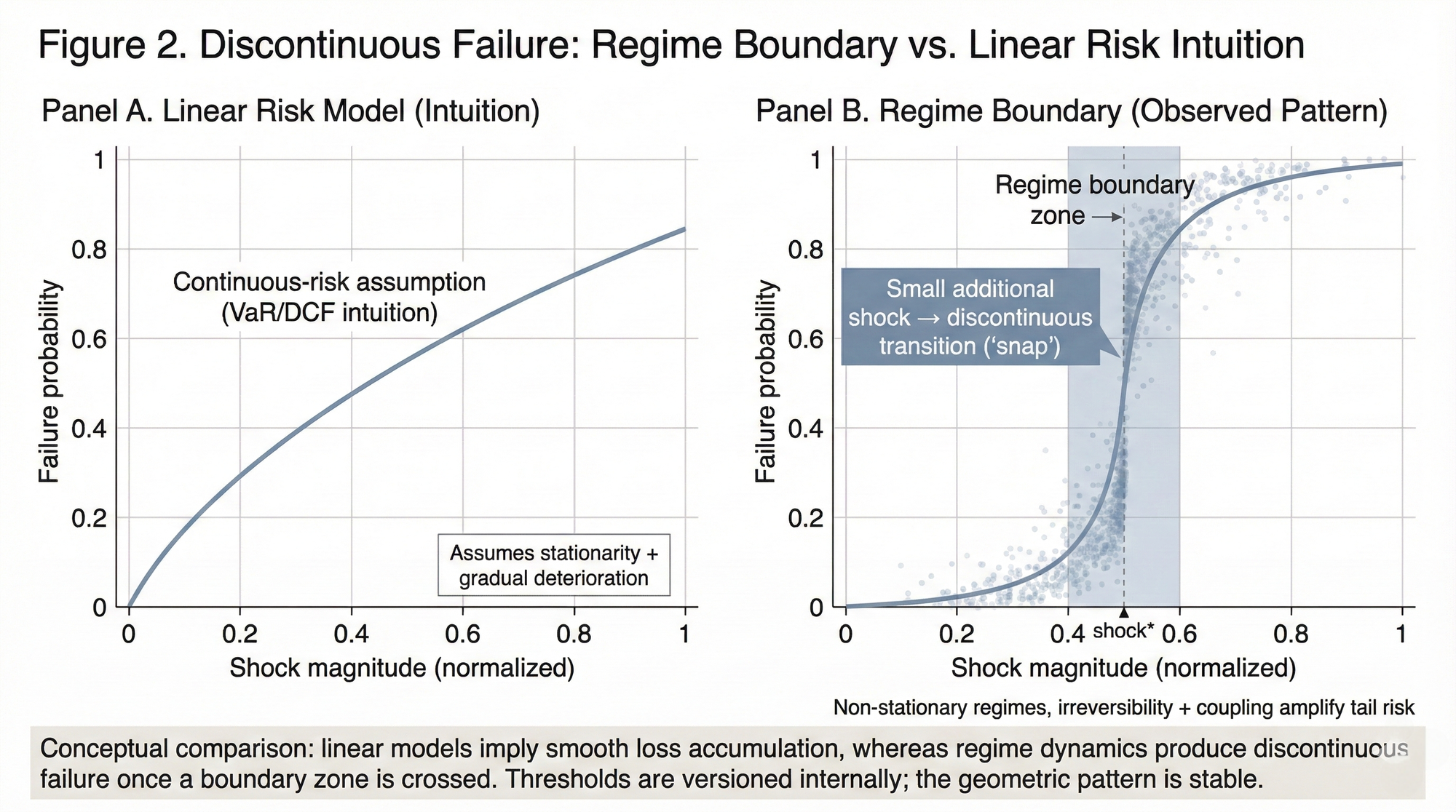
In continuous systems, small inputs produce small outputs. Traditional risk management is built for that world: diversify, hedge, insure, buffer, and the distribution behaves. But phase transitions are different. Water behaves like water until it becomes ice. The system does not smoothly drift into “slightly more solid.” It reorganizes.
Something similar happens in transition finance. Many project models assume that under stress, cash flows degrade smoothly and can be managed with incremental actions: cut costs, raise prices, refinance, sell non-core assets, extend timelines, renegotiate contracts. Sometimes they can. But in certain regimes, the project does not become “a little worse.” It becomes discontinuously different:
- Refinancing requires terms the asset cannot bear.
- Asset resale has no meaningful floor (specialized capital collapses into salvage).
- Counterparties exercise exit options precisely when you need stability.
- Interconnection and standards timelines invalidate financing windows.
- Policy deltas break assumed economics even when policy remains “supportive” in absolute terms.
This is why linear risk models often mislead in regime churn. They assume stationarity. But the transition is non-stationary by design: success reshapes the regime itself.
2. The Diagnosis: Irreversibility and Coupling
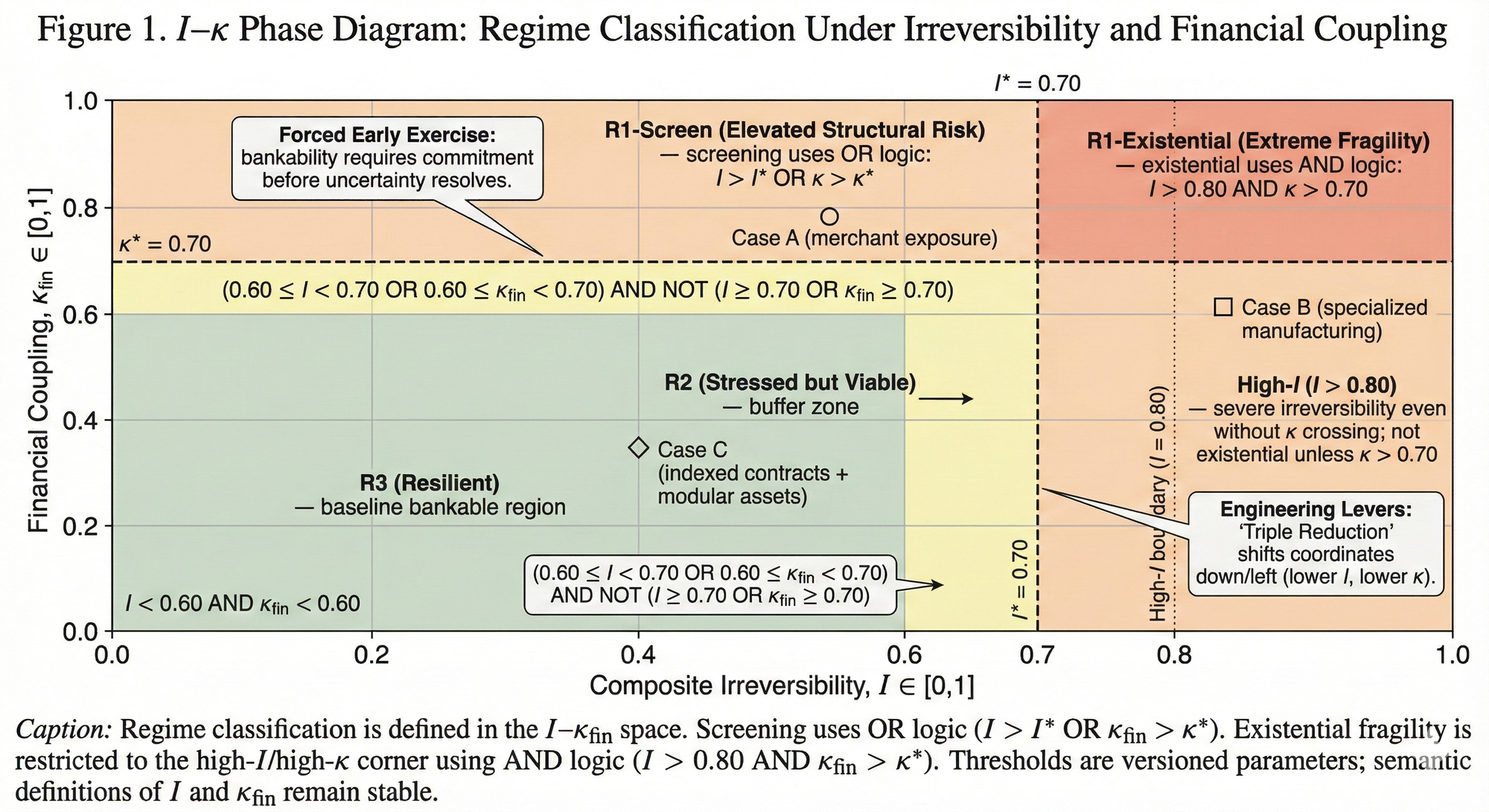
To make discontinuity operational, we need two concepts that can be observed in real diligence without slogans: irreversibility and coupling.
Irreversibility: “How expensive is it to unwind commitments?”
Irreversibility is the degree to which commitments cannot be unwound without destroying value. It includes:
- Physical specificity: how fungible the equipment and assets are (salvage floor, repurposability).
- Commercial lock-in: pricing power fragility, margin compression susceptibility.
- Supply-chain rigidity: vendor concentration and switching costs.
- Contract fragility: how easily revenue evaporates (termination optionality).
- Regulatory lock-in: dependence on a specific policy or compliance pathway.
- Organizational specificity: how redeployable the workforce and capability stack are.
Coupling: “How dependent is survival on external regime stability?”
Coupling is the degree to which the project’s viability depends on external regimes remaining stable—contract rules, counterparty quality, market design, interconnection dynamics, standards evolution, permitting behavior, and capital markets. It is not a moral judgment. It is a structural dependency.
The Trap: Forced Early Exercise
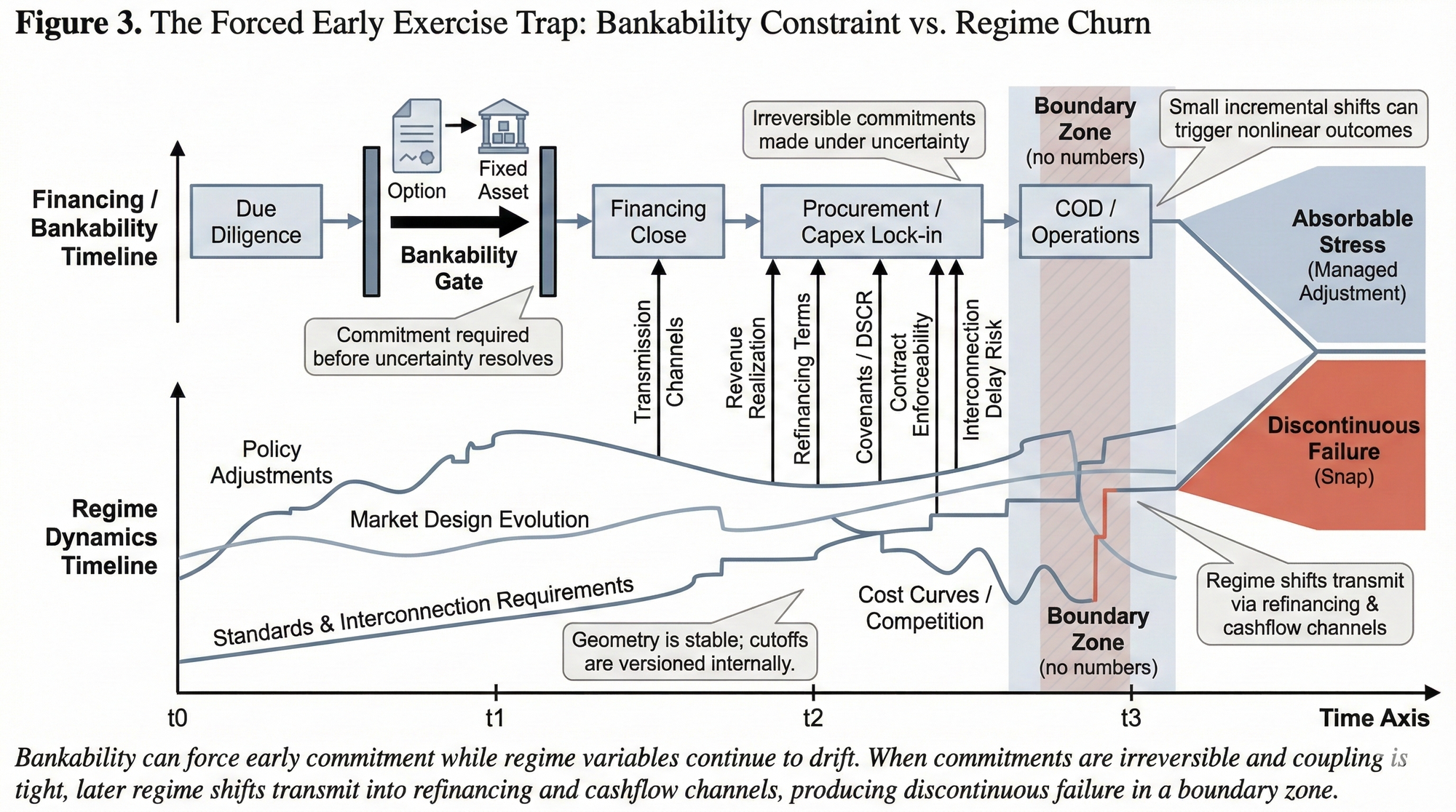
Here is the structural mechanism that produces “snaps”:
When irreversibility is high and coupling is tight, projects must commit early to become bankable—but that commitment destroys flexibility. Waiting would have option value, but committing is mandatory. The project cashes its flexibility before it has enough information. If the regime moves during that window, the project cannot adapt at the required speed.
This is not a psychological trap. It is a financing trap.
3. The Moving Target: Regime Churn as a Feature, Not a Bug
Clean energy is uniquely exposed to discontinuities not because the technologies are inherently “worse,” but because the transition often combines three destabilizers:
- Capital intensity (decisions are lumpy and front-loaded)
- Institutional sensitivity (policy and standards evolve on political and reliability timelines)
- Market-shape evolution (price distributions change as penetration rises)
That third point is regularly under-modeled. Many investors model price level and volatility, but not distribution shape. As penetration rises, the distribution can develop new tails: more frequent negative prices, curtailment clusters, ancillary service repricing, and new congestion patterns.
This is why the same asset with the same technology can become less bankable over time—not because it got “worse,” but because the system learned.
Concrete anchors
To make the abstract real, here are three recognizable regime churn pathways:
- Policy adjustments that are “small” in level but lethal in delta.
Consider the dynamic of distributed solar economics when compensation rules shift. When California moved from earlier net-metering regimes toward NEM 3.0’s export compensation structure, the systemic message was not “solar is bad,” but “the revenue formation rule changed.” For firms whose economics were tightly coupled to the previous regime (customer acquisition costs, payback narratives, financing assumptions), the shift can behave like a cliff rather than a slope.
Vignette 1: The Tariff That Didn’t Look Like a Cliff (NEM-style shift)
- Market design evolution that changes tails, not just averages.
In Texas, ERCOT’s increasing frequency of negative pricing hours and shifting value pools between energy, ancillary services, and congestion can transform merchant exposure. If an asset’s structure assumes “normal” price patterns, the transition’s success can make that assumption false. This matters most for capital stacks that cannot tolerate a few quarters of regime-misaligned cash flows.
Vignette 2: When the Distribution Changes Shape (ERCOT-style evolution)
- Standards and interconnection complexity that becomes a regime in itself.
As grids modernize, requirements increase: smarter inverters, new testing layers, communications expectations, cybersecurity attestations, and queue-driven schedule variance. Each additional compliance layer can create timeline risk that finance was not built to endure. Reliability improves while marginal projects become fragile.
Vignette 3: The Invisible Ratchet (Standards + Queue as a Regime)
The underlying point is not the particulars of any one jurisdiction. It is that regime churn is structural—and often accelerates with success.
4. Why “Low Risk” Can Be a Bad Project
A base-case IRR can look excellent precisely because a project is tightly aligned to today’s regime and has cashed flexibility early:
- tight leverage
- thin liquidity
- brittle contracts
- schedule aggression
- concentrated vendors
- narrow market exposure
These choices can produce a beautiful spreadsheet in stable conditions. But in a world where the regime will move, they increase the probability of discontinuity. This is why “low-risk” can be a mirage: it is often just high coupling disguised as stability.
Conversely, some projects labeled “high risk” are high-variance because they preserve option value and survive multiple future states. The difference isn’t philosophical. It is encoded in commitments.
5. The Solution: Triple Reduction
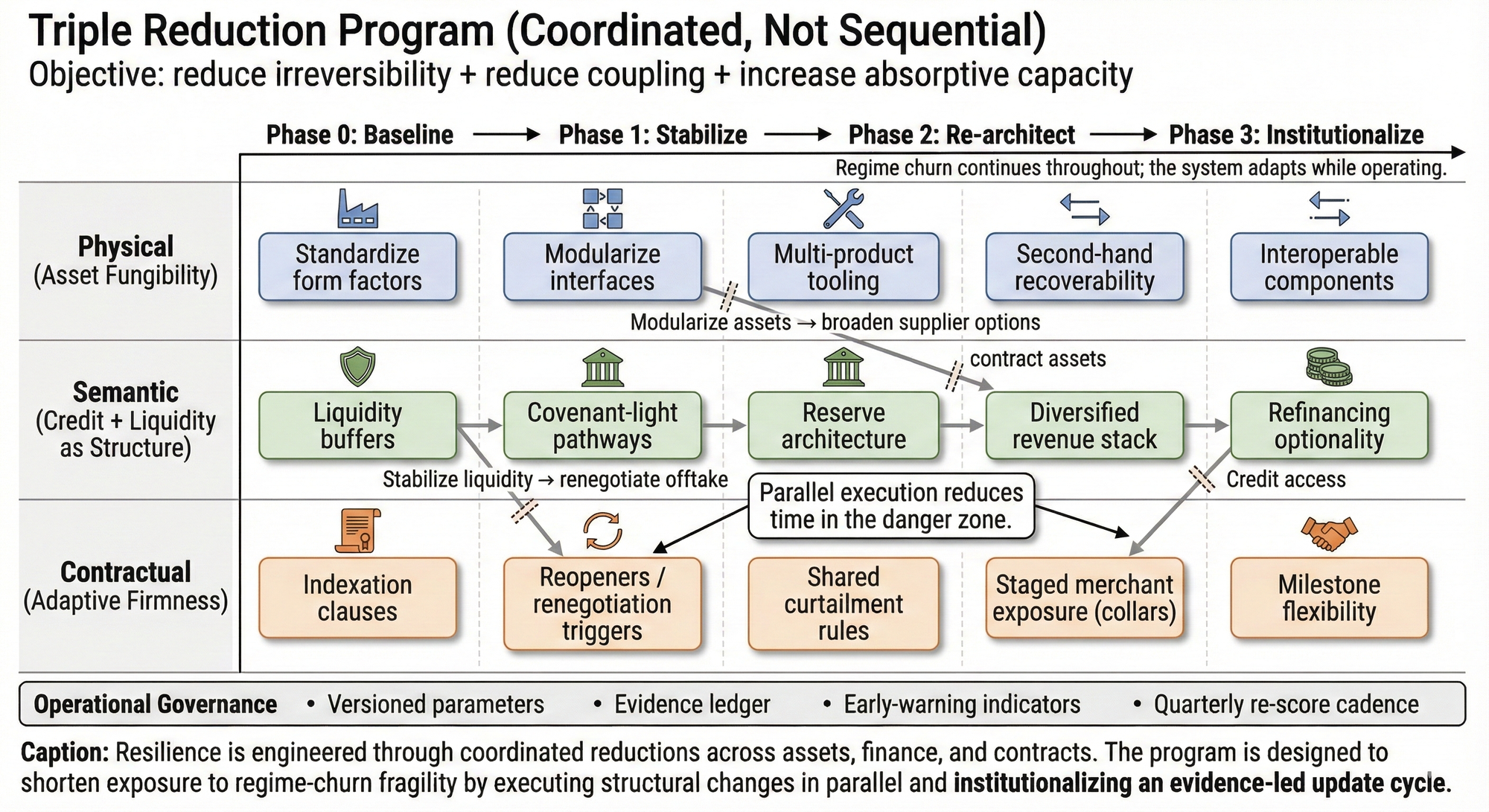
The most reliable survival strategy under regime churn is not one trick. It is coordinated redesign across three layers. Not sequentially—in parallel.
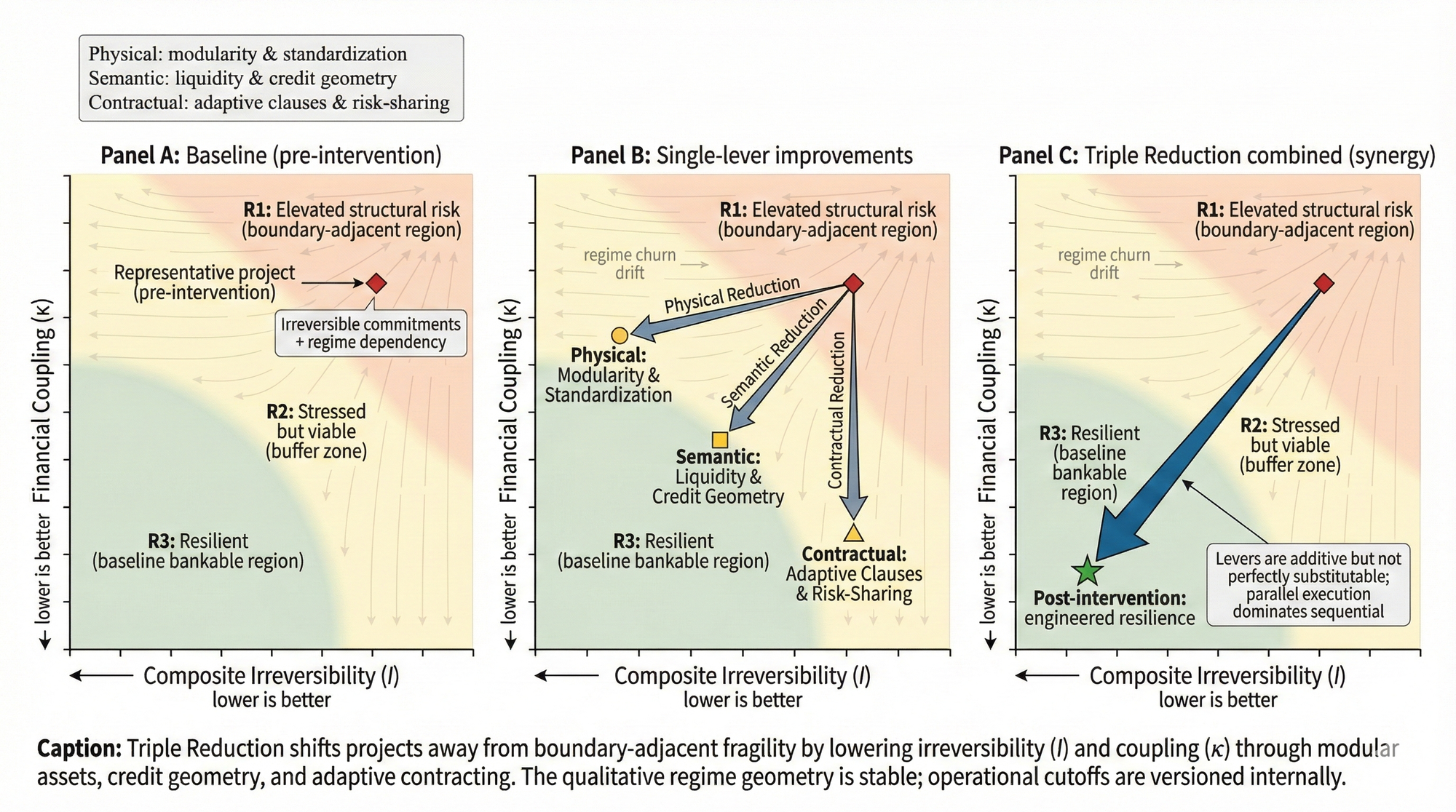
Physical Reduction: preserve exits by designing fungible assets
- Modularity and platform design over bespoke optimization
- Interoperable components over proprietary lock-in
- Multi-product tooling where feasible
- Design-to-standards so upgrades don’t require rebuilds
Principle: Standardization is not commoditization. It is option preservation. If your differentiation requires your assets to become worthless when assumptions change, you purchased performance with fragility.
Semantic Reduction: structure as credit
Most failures are not “technology deaths.” They are refinancing deaths. Semantic reduction means engineering legibility and headroom:
- Liquidity buffers that absorb schedule slip and margin shocks
- Conservative leverage that prevents minor shocks from becoming covenant events
- Diversified revenue concentration (avoid single-counterparty dependency)
- Staged commitments that avoid irreversible front-loading
Principle: If your capital structure requires perfect execution and a stable regime, it is not a structure; it is a prophecy.
Contractual Reduction: sticky revenue without brittleness
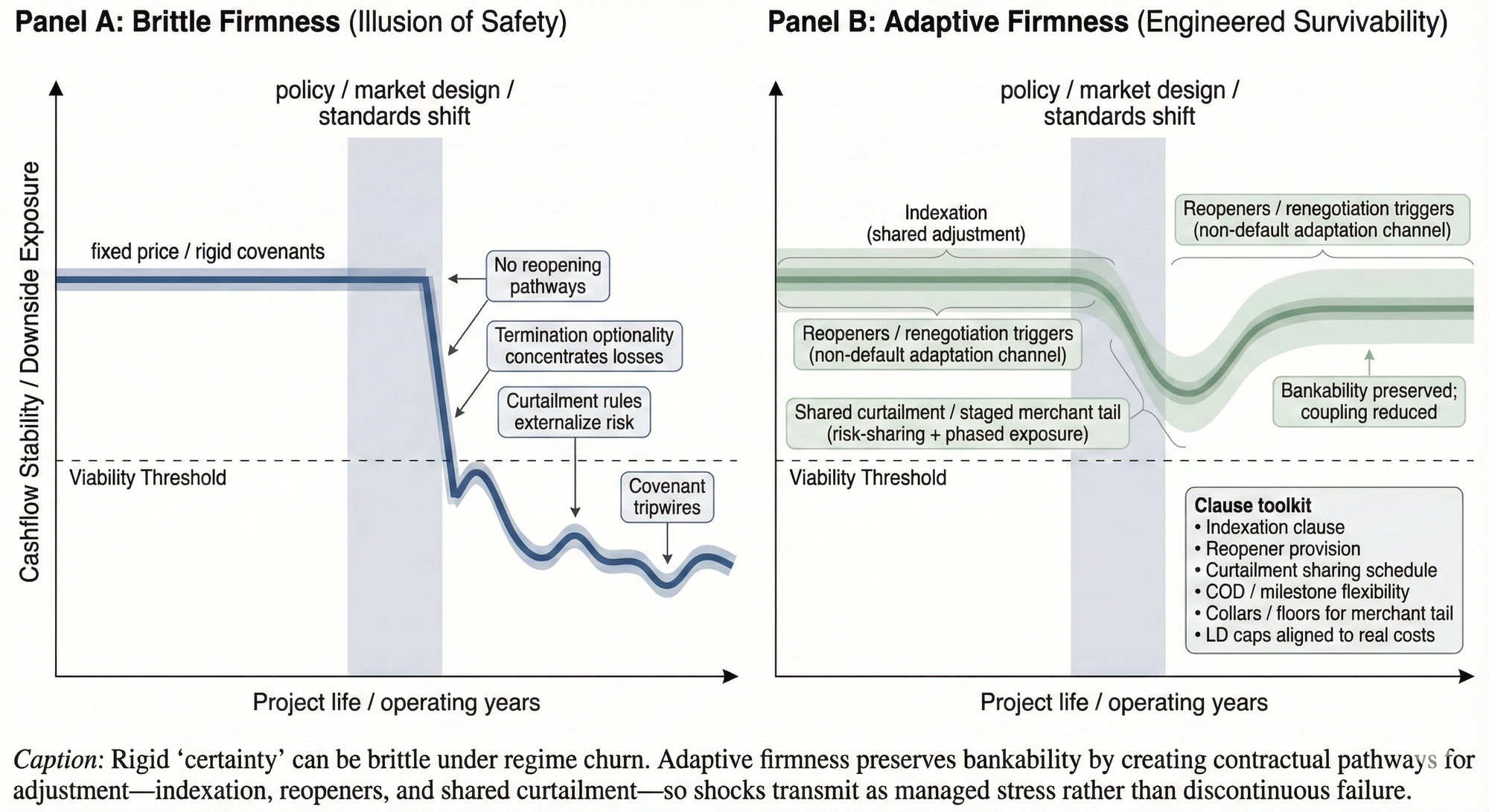
Rigid contracts can become coupling machines. Adaptive contracts acknowledge regime risk and design how it is shared:
- Indexation clauses tied to relevant regime variables
- Re-opener provisions for exogenous policy or rule changes beyond threshold
- Shared curtailment frameworks that prevent one side absorbing 100% regime shift
- Merchant tails with collars: bankability early, flexibility later
- Milestone flexibility aligned to queue reality (not optimism)
- Force majeure that recognizes regulatory delay where appropriate
Principle: In complex regimes, “simple contracts” often hide fragility. Adaptive contracts reduce the probability that adjustment arrives via default.
6. The VC–Infrastructure Clash: Power Laws vs Low-Variance Assets
A painful truth: venture capital is structurally optimized for the wrong distribution when the underlying asset is infrastructure-like.
VC portfolios are built on a power-law expectation: a few extreme winners pay for many losses. The model tolerates high failure rates because the upside is unbounded. The operational incentives—growth narratives, milestone acceleration, valuation preservation, winner-takes-most positioning—make sense in software and network businesses.
Infrastructure economics, in contrast, are closer to low-variance cash-flow logic. Long asset lives (20–30 years), debt-dominant capital stacks, and a premium on stability mean the system punishes discontinuity. The “win condition” is not an extreme outlier exit; it is durable bankability through multiple regimes.
This creates a fundamental mismatch:
- VC often pushes forced early exercise (commit now, scale now, lock in now)
- Infrastructure survival requires preserved exits and buffers (adapt later, refinance safely, tolerate variance)
When infrastructure-like ventures are forced to behave like venture-like businesses, they often increase irreversibility and coupling simultaneously: aggressive timelines, brittle contracts to justify near-term growth, thin liquidity, and concentrated exposure. Then regime churn arrives—and the business is structurally misaligned. The failure is framed as execution, but the deeper cause is distribution mismatch.
This does not mean VC is “bad.” It means capital must match regime. If a project’s value is primarily in durable cash flows, its governance and financing must be built to survive non-stationarity, not to win a valuation narrative.
7. Implications: What to Do Differently Tomorrow Morning
For Investors: stop pricing static IRR—price exits. Before debating valuation, ask whether the project has exits:
- Can core assets be resold/repurposed at meaningful value under distress?
- Are suppliers diversified enough that one relationship can’t break operations?
- Do contracts prevent revenue from evaporating overnight?
- Is counterparty quality real, or cosmetic? If weak, is there collateral support?
- Does the financing stack have headroom—liquidity and covenant space—so shocks don’t become defaults?
If too many answers are “no,” you are not in normal risk territory. You are near a boundary.
For Policymakers: predictability beats generosity
Policy doesn’t just add revenue. It adds coupling. Volatile generosity can create fragility, because the delta kills sunk-capital assumptions.
Design policy like capital infrastructure:
- clear signaling
- stable adjustment rules
- transition protocols that reduce cliffs
For Regulators and Grid Operators: queue transparency is capital formation
Interconnection and standards are not administrative details. They are regime variables. When the queue is a lottery, you select for deep balance sheets—not necessarily best innovation.
Treat queues and compliance layers as measurable economic structures:
- transparent timelines
- predictable process steps
- stable requirements where possible
- explicit phase-in pathways where change is necessary
Conclusion: Engineering Resilience
The transition is not a straight line. It is a sequence of step changes—technological and institutional. A project designed for continuity will be surprised by discontinuity. A project designed for regime churn will be less surprised—not because it predicts the future, but because it does not rely on one future.
Resilience is engineered. It is not a trait you discover after the fact. It is a set of commitments you choose before the regime moves: reduce irreversibility where you can, reduce coupling where prudent, and build buffers where neither can be fully reduced. Treat bankability as temporary alignment—not permanent achievement.
If you want a clean-energy sector that scales without unnecessary wreckage, stop smoothing away the cliff. Measure the structures that create it. Design for the world where the regime will move—because it will.
Author’s Note: This paper offers a structural lens for transition finance and institutional resilience. It is intended to improve decision-making discipline—not as investment advice. The most practical next step is to apply these concepts to a real portfolio: map irreversibility, map coupling, identify boundary proximity, and redesign structure before the regime forces redesign under duress.
Publication & Licensing
Title: The Irreversibility Trap: Why Clean Energy Ventures Fail After the System Succeeds
Version: V1.0 | December 16, 2025
Author: Alex Yang Liu
Publisher: Terawatt Times Institute | ISSN 3070-0108
Document ID: IRT-2025-v1.0
Citation Format: Liu, A. Y. (2025). The Irreversibility Trap: Why Clean Energy Ventures Fail After the System Succeeds. Terawatt Times (ISSN 3070-0108), v1.0. DOI: [To be assigned]
Copyright
Copyright © 2025 Alex Yang Liu. All rights reserved.
Permissions Granted
You are free to:
▷ Read, cite, and reference this work
▷ Use it for research, analysis, and education
▷ Share it with attribution (including internal distribution within universities, funds, utilities, and public agencies), provided you do not misrepresent authorship or provenance
Restrictions and Commercial / Engineering Use Requires Licensing
You may not:
1.Remove or obscure attribution, versioning, or document identifiers
2.Present modified derivatives as the original work
3.Use the work’s structures, thresholds, or scoring logic as a substitute for the internal engineering specification without license
Any commercial deployment, productization, or engineering implementation derived from this work requires a written license. This includes, but is not limited to:
1.Implementation of Irreversibility Regime Theory (IRT) as a scoring model, screen, classifier, or decision rule
2.Embedding irreversibility/coupling diagnostics into software, underwriting, diligence platforms, or advisory systems
3.Use of any thresholds, calibration logic, shock triggers, or regime classification rules in investment committees, risk engines, or automated decision workflows
Professional consulting applications using or materially derived from:
1)the Irreversibility + Coupling diagnostic framework
2)Regime Churn measurement concepts
3)the Triple Reduction strategy as a proprietary methodology
4)any checklists, playbooks, or parameter-ledger governance practices presented as an institutional method
Licensing & Permissions
For permissions or licensing inquiries: alex.liu@terawatttimes.org
Terawatt Times Institute
Author

Alex is the founder of the Terawatt Times Institute, developing cognitive-structural frameworks for AI, energy transitions, and societal change. His work examines how emerging technologies reshape political behavior and civilizational stability.
Sign up for Terawatt Times newsletters.
Stay up to date with curated collection of our top stories.