◀️ Previous Article | ▶️Next Article | 📚 The Series Index
Executive Summary
Extreme environments—offshore wind, desert solar, and subsurface storage—reveal how automation reshapes production. When machines stay in place and humans decide from afar, presence turns from cost into advantage. Continuous, instrumented operations capture full data cycles, making downtime rarer and prediction sharper.
Robots make waiting productive: the many hours that find nothing become the learning base for the few that prevent failure. Yet autonomy doesn’t erase accountability. Algorithms can recommend; only humans can choose and answer. New governance models—tiered shutdown rules, water auctions, and carbon-storage insurance with independent monitoring—show how ethics can scale with automation.
China’s lead demonstrates the emerging scale-and-diversity moat: vast fleets across dozens of climates learn faster and generalize better than any smaller market can replicate.
The takeaway: measure learning by diversity, not hours; treat waiting as investment, not waste. Energy sovereignty now belongs to those who can operate continuously—and remain accountable.
The storm that forced a choice
The Gulf turned steel-gray eighteen hours before the shutdown debate began. A Category 4 system bore down on a 50-turbine array sixty miles offshore, and a resident ROV at 100 meters flagged blade #17 vibrating at 4.8 Hz—amber on the risk model, 80% probability of failure within twelve hours.
Linda, the chief engineer monitoring from Houston, didn't reach for the emergency shutdown. "Three of the last five alerts at this frequency band were sensor ghosts," she told her team over comms. "If we shut down now, we're looking at a 300-600 MW hole in the grid during hospital surge hours."
The twelve-person ops team split: seven for the algorithm's immediate shutdown, five with Linda for a delayed call. The compromise was to derate to 50%, then reevaluate in six hours. The storm buried the field for thirty-six hours. The blade was fine. The sensor wasn't. The avoided penalty—measured in downtime dollars and social load—was real.
But the counterfactual haunts the decision tree: if Linda had been wrong—if the blade had fractured, struck a maintenance vessel, killed someone—the algorithm couldn't be held accountable. Linda could. That's not a bug in autonomous systems; it's the core design question: machines can monitor continuously, but humans must remain answerable for what breaks.
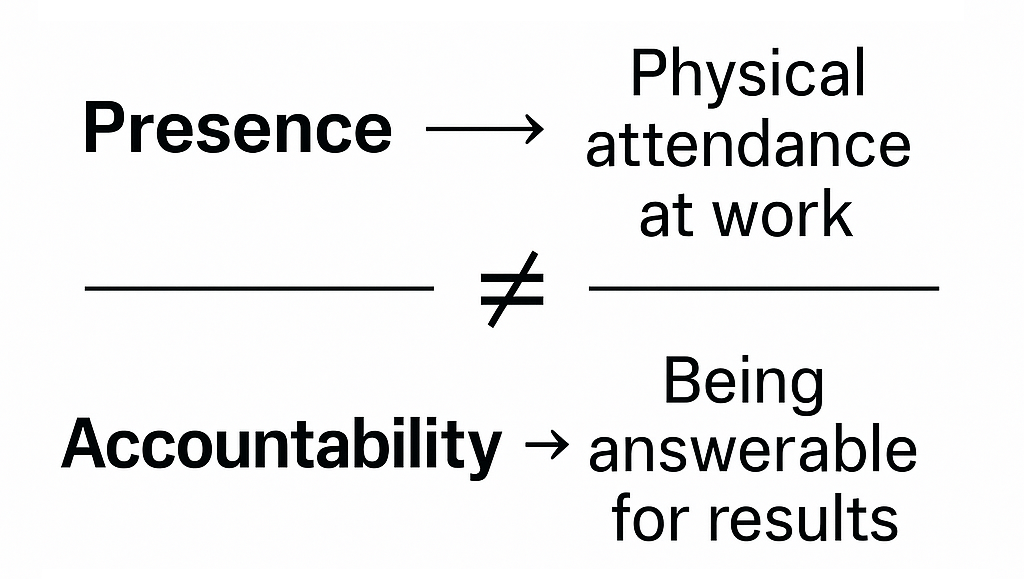
If a grid rides out thirty-six hours of violence with no human on the tower or the deck, "no one on site" clearly does not equal "no one accountable."
That distinction—between physical presence and decision authority—is the frontier in one scene. When machines remain on station continuously and people show up strategically, responsibility doesn't vanish. It moves. The real question is whether production can be sustained when human presence stops being the bottleneck, and what kind of presence still matters.
The economics of waiting
Classical O&M treats presence as cost to be suppressed. Machines flip that logic. Once a system can remain on station around the clock, presence becomes an asset with compounding returns.
The marginal value per hour of machine presence—call it Presence Premium—comes from three sources after subtracting what it costs to keep that presence alive:
$$
PP(h) = \Delta \text{Data Value}(h) + \Delta \text{Uptime Recovery}(h) - \Delta \text{Carrying Cost}(h)
$$
- ΔData Value accrues because resident machines harvest full distributions, not just exceptions. Prediction works because negatives exist—the ninety percent of patrols that find nothing aren't waste; they're the scaffold for precision.
- ΔUptime Recovery dominates in offshore wind and similar high-availability systems. The value of not stopping often dwarfs the cost of fixing.
- ΔCarrying Cost—energy, depreciation, maintenance—is small by comparison and trending down.
None of these are point estimates. Power prices swing; downtime valuation methods differ. Work in bands: a 500 MW offshore array avoiding even a few hours of unnecessary stoppage converts to meaningful hourly value. Add learning value from continuous data. Subtract single-digit dollars per hour in energy and wear. The sign remains stubbornly positive, and the curve bends upward as models improve with more hours.
Remaining content is for paid members only.
Please subscribe to any paid plan to unlock this article and more content.
Subscribe NowAuthors

Alex is the founder of the Terawatt Times Institute, developing cognitive-structural frameworks for AI, energy transitions, and societal change. His work examines how emerging technologies reshape political behavior and civilizational stability.

U.S. energy strategist focused on the intersection of clean power, AI grid forecasting, and market economics. Ethan K. Marlow analyzes infrastructure stress points and the race toward 2050 decarbonization scenarios at the Terawatt Times Institute.
Sign up for Terawatt Times newsletters.
Stay up to date with curated collection of our top stories.