Executive Summary
The clean energy transition suffers from a fundamental structural problem: ecosystem participants operate in incompatible risk regimes, making most attempted connections fail regardless of execution quality. This paper introduces the 15-Cell Resource Ontology, a framework that maps the entire clean energy ecosystem through the intersection of three risk regimes (Existential, Commercial, and Performance) with five participant categories (Solutions, Assets, Load, Capital, and Enablement).
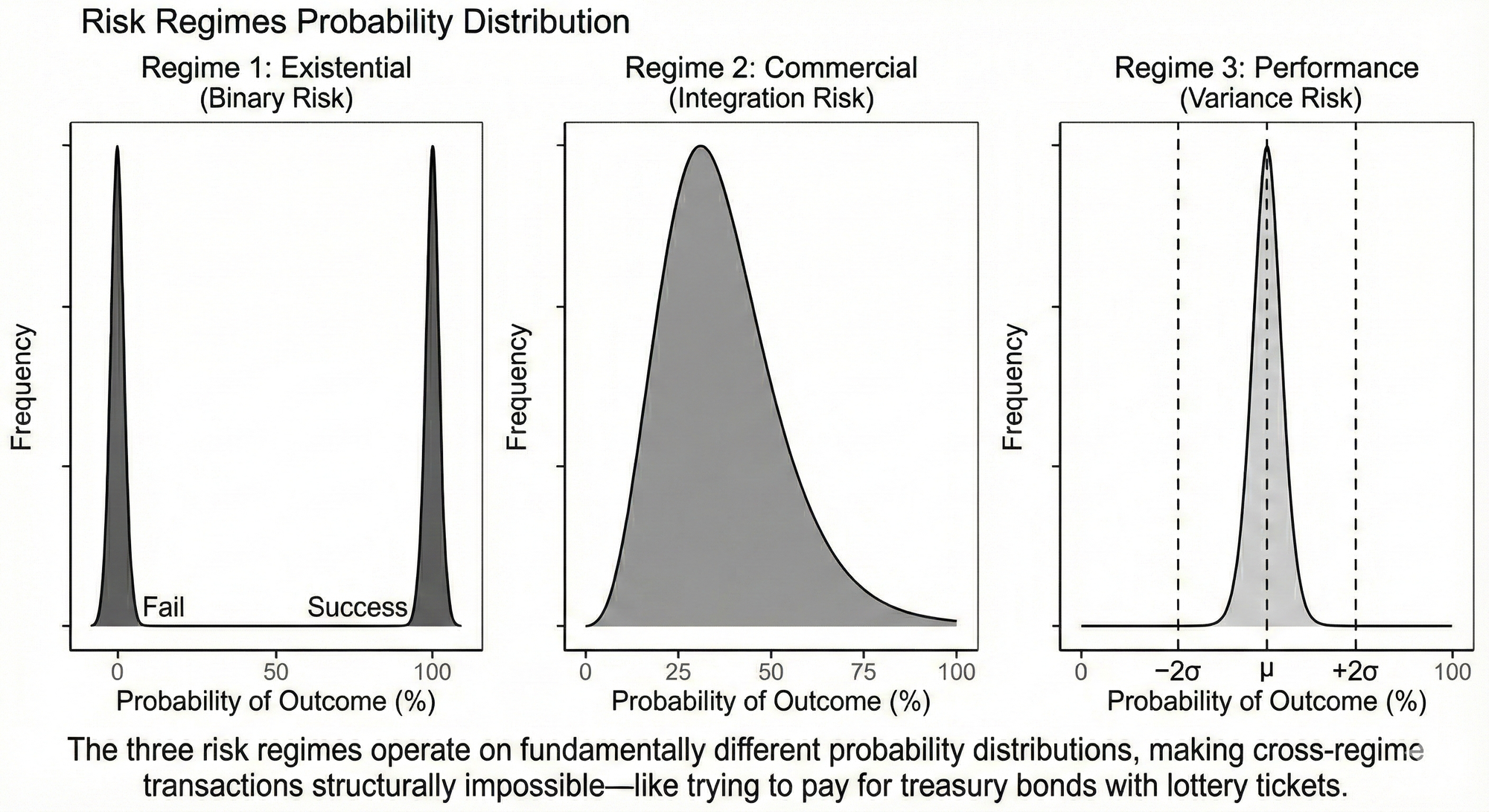
The core insight: market failures stem not from lack of connection but from "risk currency incompatibility"—early-stage ventures trade in binary risk while utilities purchase only variance risk, like trying to buy treasury bonds with lottery tickets. By diagnosing structural position before strategy, organizations can distinguish genuine opportunities from structural impossibilities, where success probability falls below 5% regardless of effort.
The framework enables geometric navigation through multiple evolutionary paths, construction of structural advantages through strategic positioning, and system-level coordination across previously incompatible participants. As the clean energy transition accelerates, mastering this structural science will separate organizations that shape the energy future from those that waste resources pursuing structurally impossible matches.
The clean energy transition operates in a state of systematic mismatch. A solar technology startup with proven physics spends eighteen months pursuing utility contracts before discovering what should have been obvious from day one: early-stage solutions cannot sell to grid-scale buyers. Not because the technology lacks merit, not because the sales team underperformed, but because these entities exist in non-adjacent risk regimes that speak incompatible languages of value. The startup trades in binary risk—their technology either works or it doesn't. The utility purchases only variance risk—proven assets with predictable deviation from expected returns. This is not a sales problem. It is a currency problem.
After scanning dozens of climate platforms across technologies, assets, demand, and financing, a pattern emerges that explains why the ecosystem generates such persistent friction despite unprecedented capital availability and technological progress. The challenge isn't connection or discovery. It's structural. The clean energy economy operates without a unified theory of how its components relate, leading to billions in misdirected capital and years of wasted effort as organizations attempt matches that the underlying architecture makes impossible.
The Three Risk Regimes That Define Everything
The fundamental insight that unlocks ecosystem navigation is this: every participant in the clean energy transition exists within one of three risk regimes, and these regimes determine what connections are possible versus impossible. This isn't about maturity or time—it's about the nature of uncertainty itself.
Regime 1: Existential Uncertainty operates on binary logic. The core question is "Is it physically possible?" A new battery chemistry, a novel solar cell architecture, a breakthrough in green hydrogen—these exist in a space where the outcome is essentially binary. The technology either achieves its promised performance or it doesn't. There is no partial credit. Venture capital thrives here, accepting 90% failure rates for the possibility of infinite returns. This is the regime of power laws, where one success pays for a hundred failures.
Regime 2: Commercial Uncertainty shifts to integration risk. The physics work, but can the unit economics support a business? Can supply chains scale? Can systems integrate? This is the valley of death where binary-risk capital has exited but yield-seeking capital cannot yet enter due to lack of performance history. The valuation logic shifts from possibility to profitability, from invention to replication. Growth equity and project finance inhabit this space, seeking proven concepts that need capital to scale.
Regime 3: Performance Uncertainty deals only with variance risk. The technology is standardized, the business model proven. The only remaining uncertainty is operational deviation—weather patterns affecting solar output, grid curtailment impacting revenues, interest rate changes affecting returns. Infrastructure funds and institutional capital dominate here, seeking predictable yields with minimal standard deviation. Their mandates explicitly forbid taking binary or integration risks, creating hard walls between regimes.
Consider a recent example from California's distributed energy market. A venture-backed software company developed an AI platform for optimizing battery storage dispatch. After raising $15 million in Series A funding, they spent a year trying to sell directly to Pacific Gas & Electric. The inevitable failure wasn't due to product quality or relationship building. PG&E, operating in Regime 3, cannot purchase Regime 1 solutions. The regulatory framework, procurement processes, and risk management protocols make it structurally impossible. The company eventually pivoted to selling through aggregators who could absorb the technology risk—a two-year detour that proper structural understanding would have prevented.
The 15-Cell Architecture of Reality
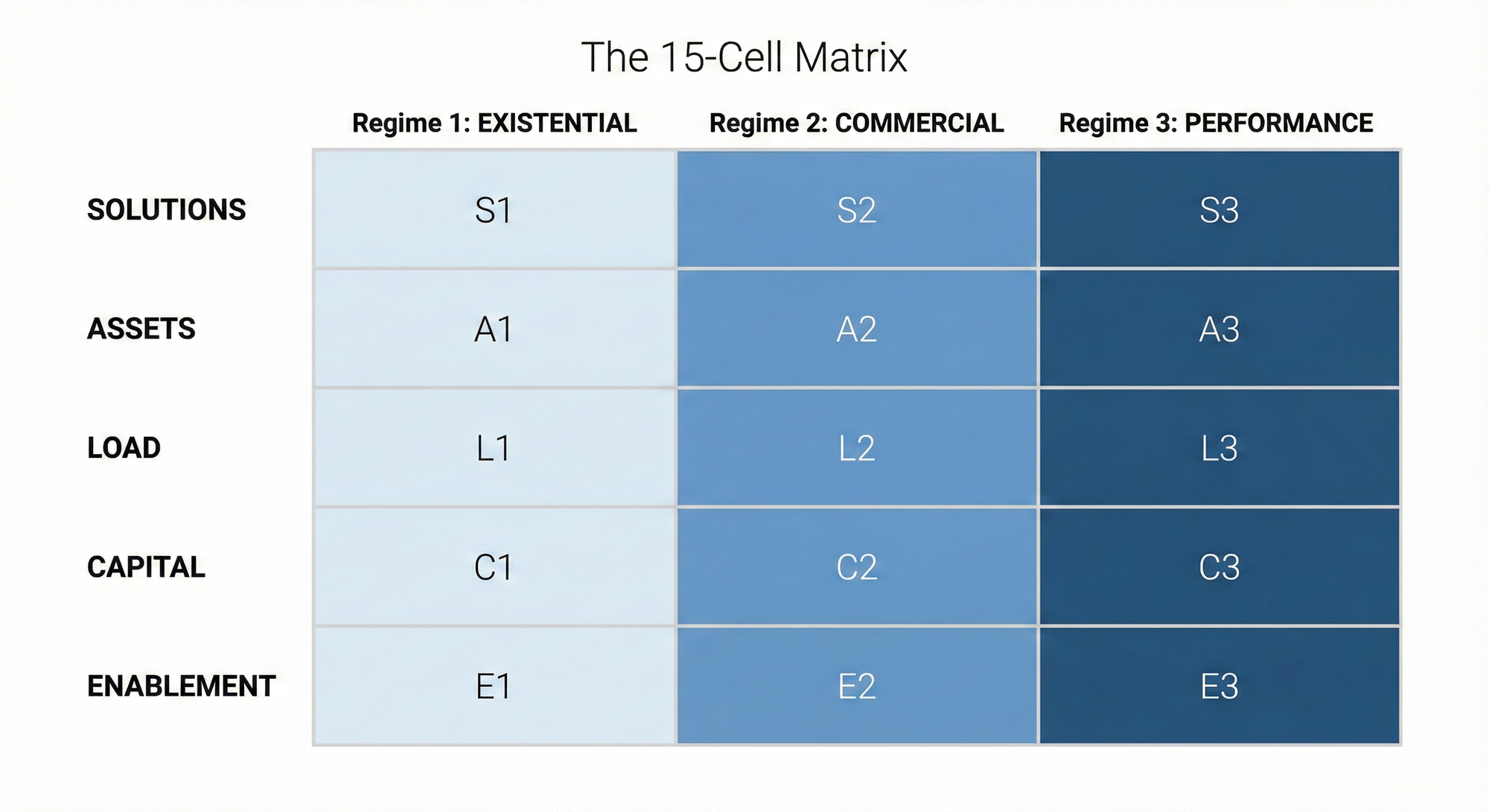
Overlaying these three risk regimes across five fundamental categories of ecosystem participants creates a 15-cell matrix that maps the entire clean energy landscape with mathematical precision. The five categories—Solutions, Assets, Load, Capital, and Enablement—represent not sectors or industries but functional roles in the ecosystem's operation. Each exists across all three risk regimes, creating distinct behavioral patterns and matchability constraints.
Solutions span from experimental technologies in university labs (S1: Existential) through commercially deploying platforms (S2: Commercial) to mature, utility-grade systems (S3: Performance). Assets evolve from early-stage land assemblies fighting for permits (A1: Existential) through ready-to-build projects with secured interconnection (A2: Commercial) to operating portfolios generating predictable cash flows (A3: Performance). Load ranges from experimental corporate buyers testing new approaches (L1: Existential) through industrial facilities planning multi-year procurement (L2: Commercial) to utilities managing grid-scale integration (L3: Performance).
Capital follows the same pattern: venture funds comfortable with binary risk (C1: Existential), growth and infrastructure investors seeking scaling opportunities (C2: Commercial), and pension funds requiring stable yields (C3: Performance). Even Enablement—the validators, lawyers, and facilitators—operates across regimes: early-stage certification bodies defining new standards (E1: Existential), transaction advisors structuring novel deals (E2: Commercial), and established intermediaries managing mature markets (E3: Performance).
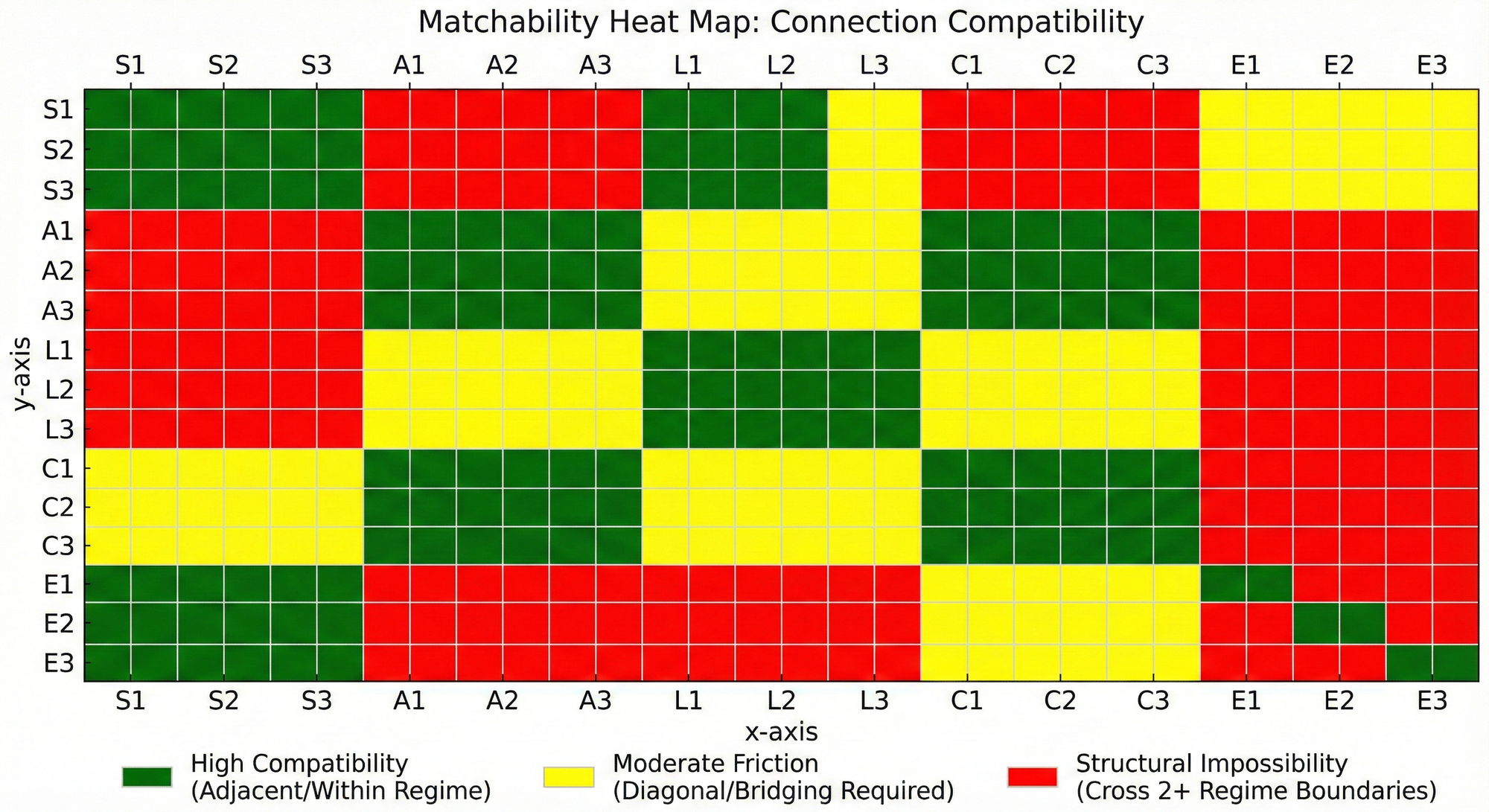
This classification reveals why certain connections persistently fail. When Regime 1 solutions attempt to sell to Regime 3 load, they're not just crossing functional boundaries—they're attempting to bridge incompatible risk languages. We use "structural impossibility" in a practical sense: cases where friction and misalignment make the effective probability of success negligibly small, typically below 5%.
Diagnosing Position Before Strategy
Understanding one's position in this 15-cell matrix transforms strategic planning from aspiration to navigation. The diagnostic function answers the question haunting every climate venture: "Is this difficult because we're executing poorly, or because it's structurally impossible?" This distinction alone can redirect years of effort from doomed pursuits to viable pathways.
A concrete example illustrates the diagnostic power. A distributed energy resource company with innovative demand response technology identified large industrial customers as their primary market. Traditional analysis would examine product-market fit, competitive dynamics, and sales strategy. Structural analysis revealed a different reality: the company occupied position S1 (Existential/Solutions) while targeting L2 customers (Commercial/Load). The risk regime mismatch meant that regardless of product quality, the sales cycle would extend beyond the company's cash runway. The structural prescription was clear: first establish credibility with L1 early adopters, use those proof points to attract C2 growth capital, then approach L2 customers from a position of commercial validation. This isn't just sequencing—it's structural necessity.
The diagnostic process operates as comprehensive risk archaeology, excavating hidden dependencies and constraints. Are all necessary cells identified for your business model? Which positions must be occupied sequentially versus simultaneously? What bridges through Enablement positions are mandatory versus optional? Where do regulatory or technical standards create walls between positions? This systematic examination prevents the most common failure mode: assuming that execution energy can overcome structural impediments.
The value of structural diagnosis compounds at the earliest stages. Before incorporation, before capital raising, before product development, founders can validate whether their imagined pathway has structural viability. The asymmetry is striking: early structural validation costs almost nothing while structural ignorance often proves fatal. In clean energy, where technical development cycles stretch years and capital requirements reach millions, this early warning system becomes essential infrastructure.
Multiple Futures Through Geometric Navigation
Structure determines not just current position but the full space of possible futures. Every organization faces multiple evolutionary paths through the matrix, each with distinct requirements, timelines, and probabilities of success. These aren't just strategic options—they're fundamentally different structural destinies.
A technology company at S1 might pursue technical deepening toward S3, requiring patient capital and accepting long development cycles. Alternatively, they might integrate horizontally with A1 assets, building projects that demonstrate their technology while generating early revenue. Or they might focus on rapid validation with L1 customers, accepting lower prices for faster proof points that unlock C2 capital. Each path traces a different route through the matrix, with success probability determined by structural alignment rather than execution quality alone.
The temporal dimension adds complexity. Positions aren't static—they evolve with policy changes, market dynamics, and technological progress. The Inflation Reduction Act, for instance, has shifted the boundaries between risk regimes by providing federal backstops that convert some Existential risks into Commercial ones. What seems structurally impossible today might become adjacent tomorrow through regulatory bridges or subsidy mechanisms. Conversely, positions that seem secure can become isolated as the ecosystem reconfigures. Coal-based positions that once anchored the entire energy system now exist in structural isolation, disconnected from growth capital and new demand.
This dynamic topology requires continuous navigation rather than fixed planning. Organizations need not just a map but a navigation system that updates as the territory transforms. The framework provides both: a structural understanding of current position and a methodology for tracking ecosystem evolution.
Building Competitive Moats Through Structure
Beyond navigation lies the possibility of architectural manipulation. Organizations that understand the structural landscape can construct advantages that transcend traditional competitive moats. These emerge not from resources or capabilities alone but from positional choices that create geometric lock-in.
Consider the power of occupying bridge positions between non-adjacent cells. A company that successfully spans S2 and A2—combining commercial technology with ready-to-build projects—creates unique value that neither pure technology nor pure development players can replicate. This isn't vertical integration in the traditional sense but structural arbitrage, exploiting the inefficiencies where risk regimes meet.
The most sophisticated players recognize that organizational DNA constrains which positions they can successfully occupy. A team of MIT engineers might excel at S1 innovation but fail catastrophically attempting A3 asset management. A group of Wall Street financiers might optimize C2 capital structuring but cannot navigate S1 technology development. The framework reveals these DNA-position matches and mismatches, preventing costly attempts to force organizations into incompatible configurations.
Timing creates another dimension of structural advantage. Early occupation of emerging positions—like the space between S1 and S2 that's now crystallizing for validated but sub-scale technologies—allows organizations to define the rules of new territories. Anticipating when regulatory changes will create new Enablement requirements or when market maturation will open new Load categories creates temporal advantages that compound with geometric positioning.
The Operating System Layer
The 15-cell framework transcends analytical tool status to become operating system infrastructure for the entire ecosystem. Just as TCP/IP protocols enable internet communication regardless of hardware differences, structural understanding enables ecosystem coordination regardless of organizational differences.
This manifests through multiple mechanisms. Standardized definitions eliminate categorical confusion—when a fund says they invest in "growth-stage climate technology," the framework specifies whether they mean S2, late S1, or early A2 positions. Efficient routing prevents wasted effort on structurally doomed pursuits while highlighting unexplored but viable pathways. Dynamic optimization allows the ecosystem to reconfigure efficiently as conditions change rather than through painful trial and error.
Policy implications are profound. Rather than generic innovation support or blanket subsidies, governments can identify specific structural bottlenecks and design targeted interventions. A program recognizing the S1 to S2 transition barrier will prove more effective than broad R&D tax credits. Capital providers can map deal flow against structural positions to identify portfolio gaps. A fund might discover they're overweight in S2 positions while missing critical E1 opportunities that would unlock their portfolio companies' growth.
Systemic Dynamics and Emergent Opportunities
The ecosystem doesn't simply exist—it evolves through predictable patterns of risk propagation and opportunity emergence. Systemic shocks cascade through structural pathways: when C3 capital constrains, A3 asset prices fall, triggering A2 financing difficulties, causing S2 companies to struggle, ultimately reaching S1 innovation funding. Understanding these transmission mechanisms enables proactive positioning rather than reactive scrambling.
A recent example: rising interest rates in 2022-2023 first impacted C3 infrastructure funds' return requirements. This cascaded to A3 operating assets requiring higher yields, making A2 development projects less viable, forcing S2 companies to extend runways, and ultimately drying up C1 venture funding for S1 startups. Organizations that recognized these structural linkages early could position defensively or even benefit from the disruption.
New positions emerge at the boundaries between existing cells when ecosystem pressure builds sufficiently. The space between L1 and L2 is spawning aggregation platforms that pool small commercial demand into industrial-scale procurement. The gap between E1 and E2 is creating new verification services that bridge technical validation and financial structuring. These emergent positions often represent the highest-value opportunities because they resolve structural inefficiencies the ecosystem desperately needs addressed.
Boundary Conditions and Exceptions
While structural impossibility describes the vast majority of failed matches, exceptions exist that prove instructive. Occasionally, an S1 company does sell directly to an L3 utility—typically when government guarantees convert binary risk to variance risk, or when strategic imperatives override normal risk management. These exceptions don't invalidate the framework but rather highlight the specific conditions required to bridge normally incompatible regimes.
Tesla's early Megapack deployments offer an instructive case. Despite being an S1/S2 technology, they achieved L3 utility adoption through a combination of: balance sheet strength that absorbed technology risk, government incentives that socialized failure costs, and strategic pressure on utilities to demonstrate innovation. These special circumstances created temporary bridges across structural gaps—bridges that most organizations cannot replicate.
Understanding boundary conditions prevents both excessive pessimism and naive optimism. The framework describes probability distributions, not absolute laws. Structural impossibility means success probability below 5%, not exactly zero. For organizations with exceptional resources, regulatory advantages, or strategic importance, these low-probability paths might be worth pursuing. But they should do so with clear awareness of the structural headwinds they face.
The Transformation Imperative
The introduction of structural science to clean energy markets represents more than incremental improvement—it constitutes a paradigm shift in how we conceptualize and navigate the energy transition. Moving from transactional matching to structural alignment, from execution-focused problem-solving to architecture-aware strategy, fundamentally changes what becomes possible.
Organizations gain the ability to distinguish structural impossibility from execution challenges, preventing years wasted on doomed pursuits. They can identify and exploit structural inefficiencies that create extraordinary value. They can build advantages based on position and timing rather than just resources and capabilities. The cumulative effect accelerates the energy transition by reducing friction, preventing waste, and enabling coordination at previously impossible scales.
The framework doesn't eliminate the need for execution excellence, relationship building, or technological innovation. Instead, it provides the context within which these traditional success factors can flourish. Understanding structure helps organizations direct their execution energy toward viable targets, build relationships with compatible partners, and focus innovation on addressable challenges.
As the clean energy transition accelerates and complexifies, the need for structural navigation will only intensify. The organizations that master structural thinking will shape the energy future. Those that ignore structure will struggle regardless of their resources, technology, or intentions. The choice isn't whether to engage with structural reality but whether to do so consciously and strategically or unconsciously and reactively.
The clean energy transition isn't merely a collection of markets waiting for connection. It's a structure defined by risk regimes, geometric constraints, and evolutionary dynamics. With structural science as our guide, we can finally build the architectural awareness necessary to accelerate humanity's most critical transformation. The question now is whether we'll use this structural intelligence to navigate toward success or continue confusing incompatible risk currencies, mistaking structural impossibility for poor execution, and missing the genuine pathways that geometric understanding reveals.
Publication & Licensing
Title: Structural Impossibility: The Risk-Regime Architecture of Clean Energy Markets
Version: 1.0 | November 25, 2025
Author: Alex Yang Liu
Publisher: Terawatt Times Institute | ISSN 3070-0108
Document ID: SIRA-2025-v1.0
Citation Format: Liu, A. Y. (2025). Structural Impossibility: The Risk-Regime Architecture of Clean Energy Markets. Terawatt Times (ISSN 3070-0108), v1.0. DOI: [To be assigned]
Copyright © 2025 Alex Yang Liu. All rights reserved.
You are free to:
▷ Read, cite, and reference this work
▷ Use it for research, analysis, and education
▷ Share it with attribution
Commercial or Engineering Use Requires Licensing
This includes, but is not limited to:
Implementation of the MERITᵣ™ evaluation model
Use of the 15-Cell Resource Ontology™ in commercial products or services
Embedding structural-impossibility diagnostics into software or advisory systems
Professional consulting applications using:
– the three Risk-Regime classifications
– the Risk Currency Incompatibility construct
– structural navigation or matchability methodologies derived from this work
For permissions or licensing inquiries: alex.liu@terawatttimes.com
Terawatt Times Institute
Author

Alex is the founder of the Terawatt Times Institute, developing cognitive-structural frameworks for AI, energy transitions, and societal change. His work examines how emerging technologies reshape political behavior and civilizational stability.
Sign up for Terawatt Times newsletters.
Stay up to date with curated collection of our top stories.